


Economic Potential of Decarbonisation
Sustainability is not just a matter of compliance or environmental impact, it has real economic implications. Globally, other countries are already realising this and investing in sustainability. Australia is in a unique position now as Australian climate tech companies are scaling up, more companies are shifting towards net zero emissions, and the energy transition is underway.
As Australia is already on the path to decarbonisation, the goal is to take advantage of the economic opportunity that comes with it.
Since the early 2000s, Australia has been taking steps to reduce carbon emissions. Data shows that the peak of the country’s net carbon emissions was in 2006 at 639.7 Mt CO2-e. As of 2025, net emissions are down to 440.2 Mt CO2-e. This is further supported by the transition to renewable energy sources, where 35% of Australia electricity was renewable in 2024.
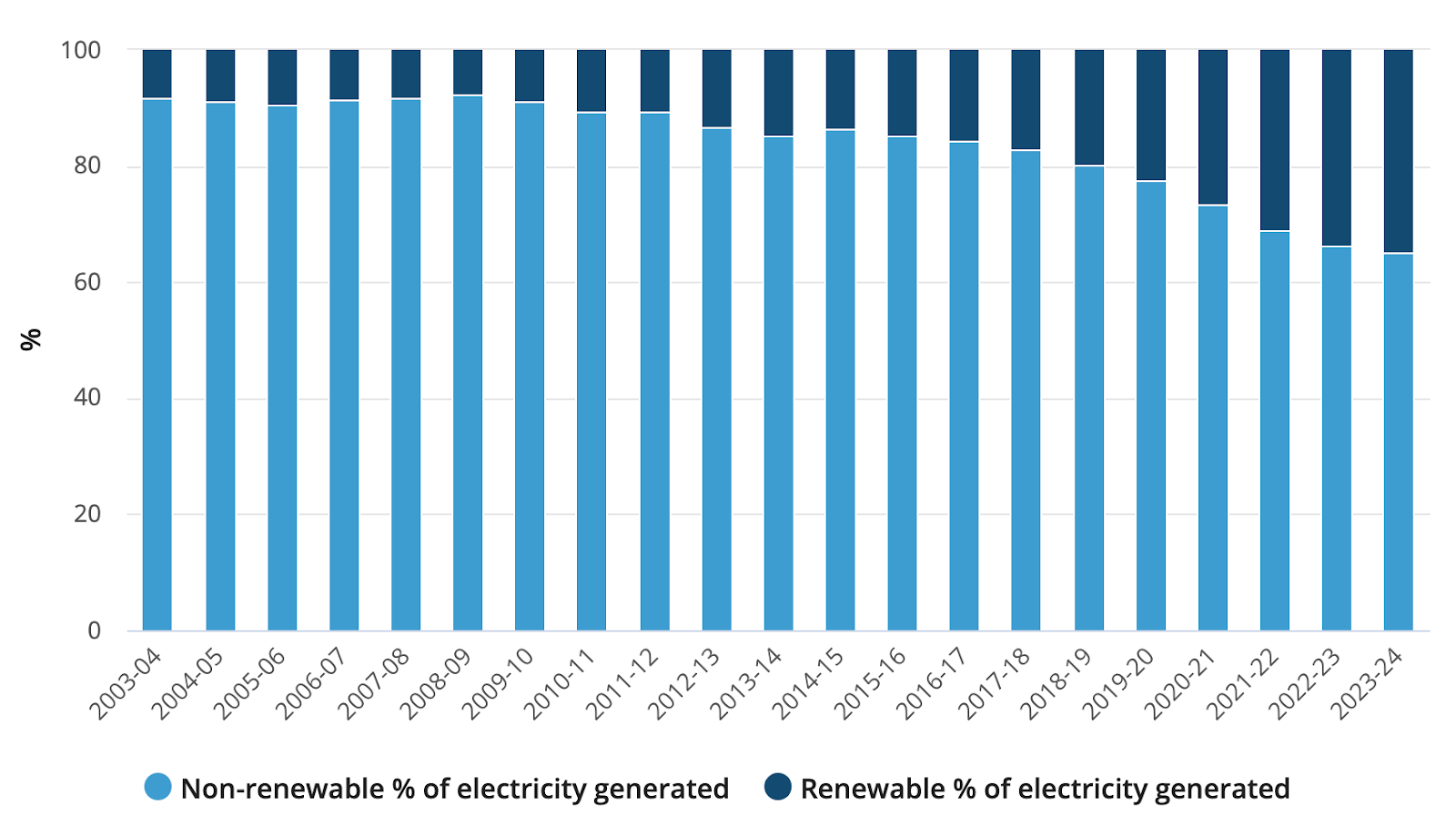
Nonetheless, the battle against global warming is still ongoing. Specific sectors are more responsible for emissions than others and need to be targeted. The Australian Government lays out a plan for this and has set up legislation and funding for the following efforts:
Australia’s scope 1 emissions are mainly caused by coal mining, mineral mining, and oil and gas extraction due to equipment usage and discharge of gases. Some actions to prevent further damage caused by this include investment in new technologies, electrification or switching to different types of fuel, properly ventilating, detecting, and fixing methane leaks in mines, and carbon sequestration.
To support the reduction of Scope 2 and 3 emissions there needs to be a focus on the energy sector, which is the largest source of emissions for Australia. Switching to renewable electricity generation, scaling and investing in clean energy, and making the produced energy more efficient are viable paths to continue producing power but reducing its environmental impact.
All this to say that decarbonisation is already underway, and Australia can capitalise on that.
Beyond policy and government action, industry is making strides when it comes to decarbonisation. DNA Energy is a startup that connects commercial buildings, and their assets to the energy grid in an optimal way that reduces unnecessary cost and energy expenditure. Another climate tech company, Capricorn Power, has developed an engine that converts waste heat into power which can be very useful in industrial or bio-gas applications. Many companies such as these have already jumped on the opportunity that decarbonisation is providing and are growing as their innovative technologies are adopted.
Many larger corporations are also realising the potential within a shift towards sustainability. By integrating more eco-friendly business practices they can more meet customer demand and gain new market opportunities. One example is the accounting software Xero. Already having practicality eliminated their Type 1 and 2 emissions, Xero is pushing out a number of new sustainability pilots, and their customers are benefiting significantly. Tapping into areas like energy efficiency, circular economy, and sustainable products can help reduce expenses and attract more environmentally conscious investors and stakeholders.
More economic opportunity that decarbonisation will bring includes higher living standards and wages projected to increase by 31% for 2035. Higher employment will be seen in fields where there is a transition to clean energy. This means that sectors like the automotive industry, engineering trades, machinery and industrial plants, construction, and manufacturing will actually see an increase in job and labour opportunities. There will also be savings at the household level, where solar panels and electrification can decrease families’ energy bills in the long run after accounting for upfront installation costs.
Australia’s Treasury Modelling and Analysis page brings up a “Disorderly Transition Scenario”. This shows that when structured carbon emissions reduction plans are not implemented gradually in a timely manner, the country will have to spend even more money to decarbonise in the future. With a solid Net-Zero plan underway, Australia is on track to minimise costs and have a higher GDP.
Global economic positioning on the climate crisis may vary from country to country, but major international players are already investing heavily in the sustainability industry. For example, China has doubled its investments in renewables since 2015, and the EU agreed on the Net-Zero Industry Act in 2024. In the United States, $6.6 trillion out of $61.7 trillion investments in assets under management were ESG or sustainability related. Australia must also jump on this opportunity and capture this new market.
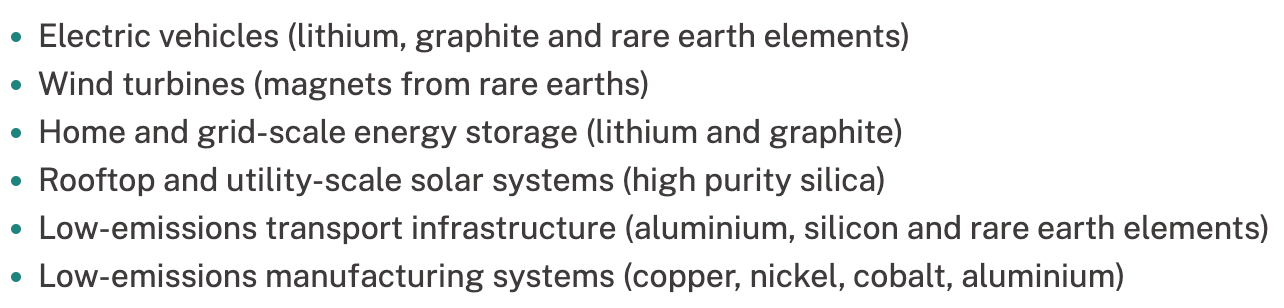
Luckily, Australia has a lot of innate advantages that can benefit them in this area. Unlike some other nations, the Australian Government is in support of sustainability and has plans and policies to reduce 2035 emissions to 62-70% below 2005 levels by 2035. More Australian innovations in the climate field are being developed and getting recognition. Australia also has many available metal and mineral resources which are extremely important in producing and scaling climate technologies. This is especially complemented by strong trade relations and proximity to Asia, as Asia has a lot of demand for natural resources for sustainable technology.
Here is a list of Australian metal and mineral resources that can be used in the Net-Zero transition:
Decarbonisation grants a significant economic opening for Australia. This opportunity depends on more growth in government policy, renewable energy, climate technology, and global trade. While there are already many players capitalising on this, there is still much more room to expand. Effective and strategic investment in this new market and its future will not just bring environmental but also financial gain.
Sources
- Emissions reduction | Australian Bureau of Statistics
- Resources Sector Plan
- Electricity and Energy Sector Plan - DCCEEW
- DNA Energy
- Capricorn Power
- Sustainability at Xero
- Australia’s Net Zero Transformation: Treasury Modelling and Analysis
- China – World Energy Investment 2025 – Analysis - IEA
- Net-Zero Industry Act - European Commission
- US Sustainable Investing Trends 2024/2025 | US SIF
- Net Zero - DCCEEW
- The resources sector pathway to net zero
More from
Industry
category


